Provider or Deployer? Which Article 50 Obligation Applies to You
6 min read
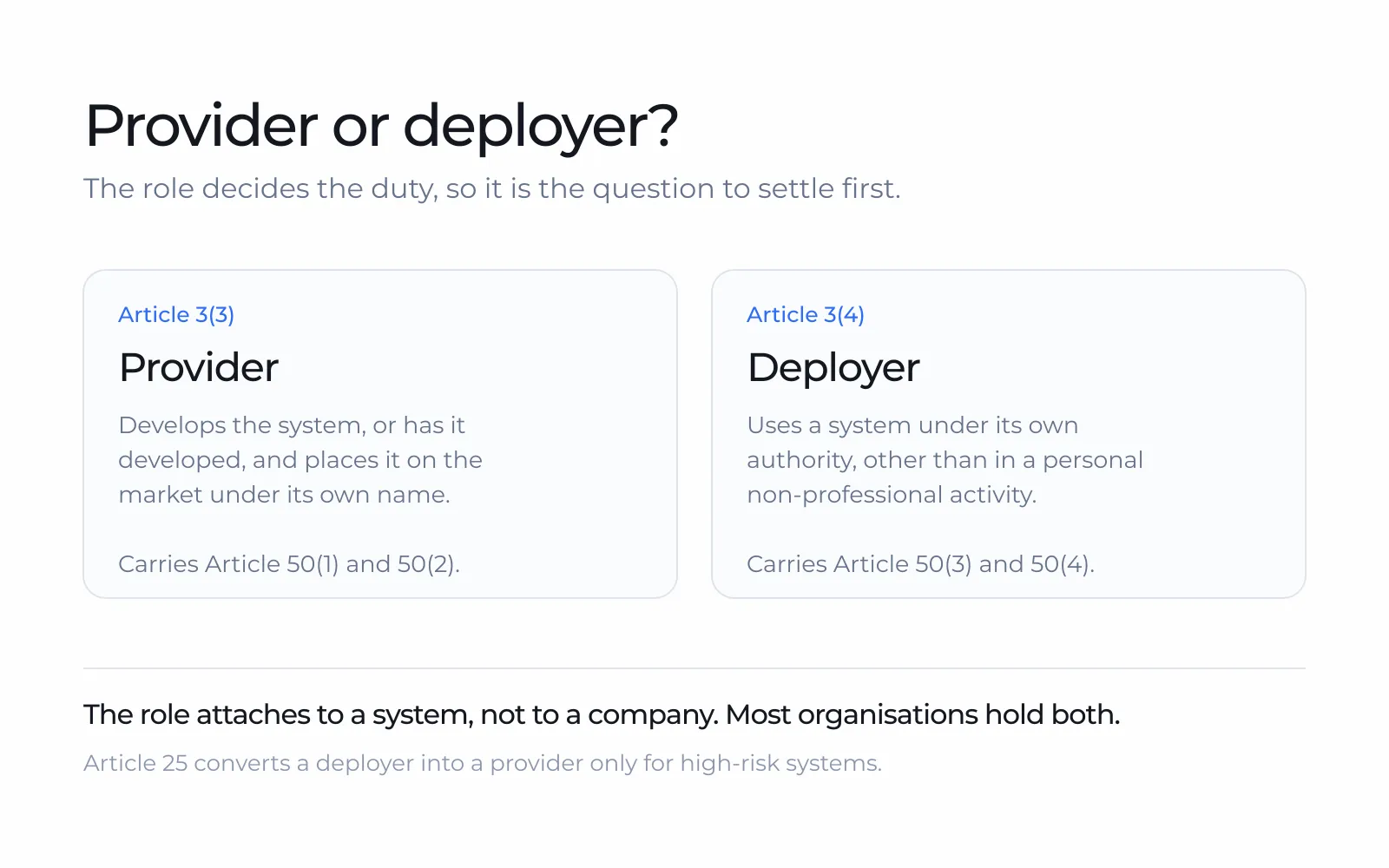
If you use an AI system someone else built, Article 3(4) makes you a deployer, and your Article 50 exposure runs through Article 50(4) rather than Article 50(2). You cross into being a provider under Article 3(3) by developing a system, or having one developed, and placing it on the market under your own name or trademark.
Almost every practical Article 50 question resolves into this one first, and answering it in the wrong order wastes the rest of the work. A team that reads Article 50(2), concludes it needs to embed machine-readable marking, and starts scoping a watermarking project has usually just adopted a duty that belongs to its tool vendor.
The role decides the obligation, so settle it first
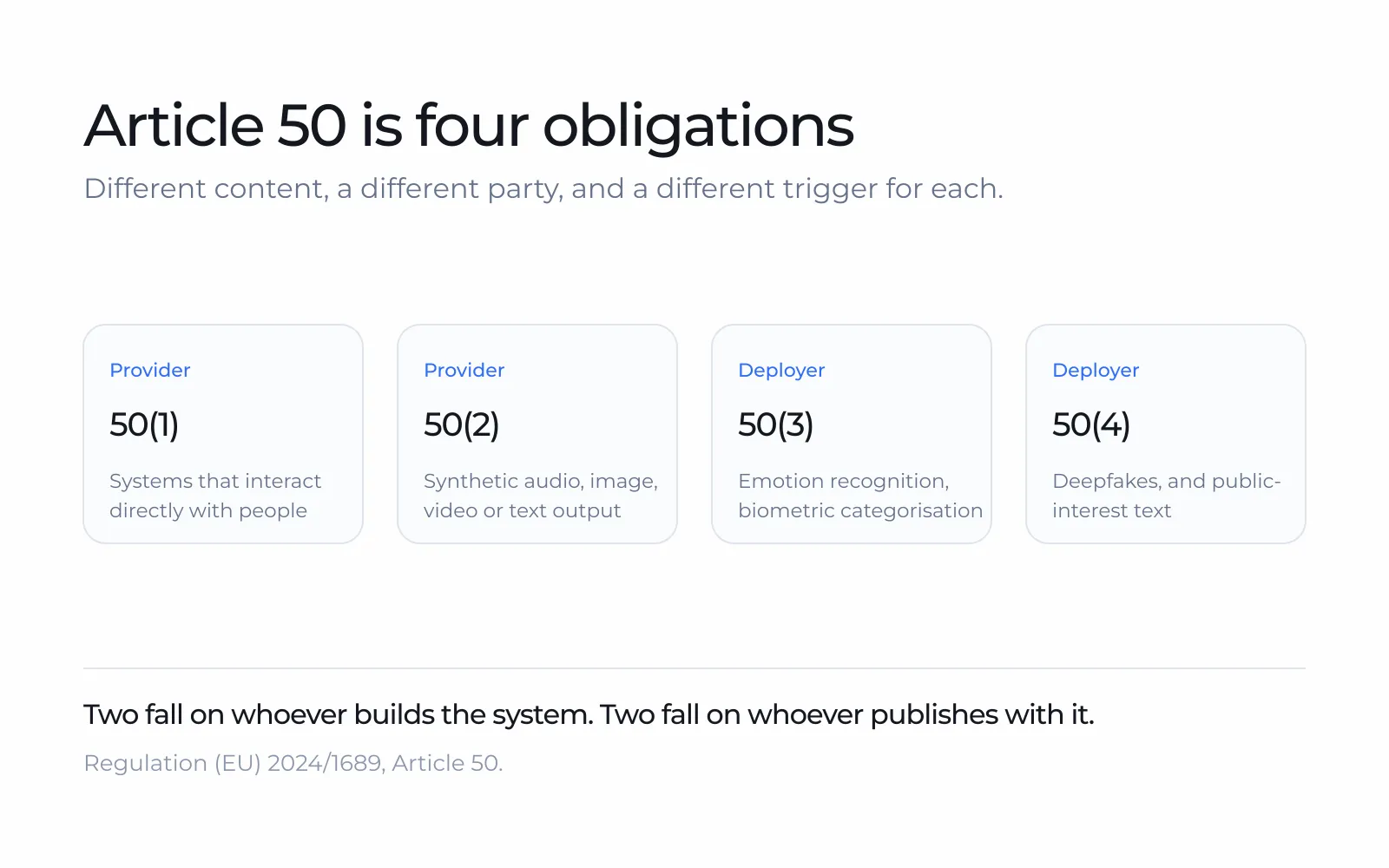
Article 50 splits along the provider and deployer line, and the two halves have almost nothing in common:
The roles attach to an AI system, not to a company. The same organisation can be a provider of the feature it sells and a deployer of the twenty tools it buys, and the answer has to be worked out for each.
What makes you a provider under Article 3(3)
‘provider’ means a natural or legal person, public authority, agency or other body that develops an AI system or a general-purpose AI model or that has an AI system or a general-purpose AI model developed and places it on the market or puts the AI system into service under its own name or trademark, whether for payment or free of charge.
Two limbs, and both have to hold:
“Whether for payment or free of charge” closes the obvious gap. Shipping a free tool does not move you out of the definition.
The phrase carrying the most weight is “has an AI system developed”. Commission a bespoke system from an agency, put your brand on it and release it, and the first limb is met even though nobody in your company wrote any of it. Buying a seat on a system somebody else operates and markets is a different thing entirely.
Article 3(68) adds a related role for anyone building on top of a model. A downstream provider is a provider of an AI system that integrates an AI model, whether that model is their own or another party’s. If you wrap a third-party model in your own product and sell it under your name, that is the definition you are reading.
What makes you a deployer under Article 3(4)
‘deployer’ means a natural or legal person, public authority, agency or other body using an AI system under its authority except where the AI system is used in the course of a personal non-professional activity.
This is a wide definition and it is meant to be. “Using an AI system under its authority” covers a marketing team generating campaign images, an agency doing it for a client, a retailer producing product visuals, and a newsroom drafting copy. No technical involvement is required and no contract with the model vendor beyond ordinary use.
The Commission’s FAQ describes deployer use as professional activity, including activity that provides an economic benefit. That framing matters more than the word “business”: a sole trader, a freelancer and a non-profit publishing to promote its work are all engaged in something other than a personal non-professional activity.
Can a deployer become a provider?
Yes, but not by the route most commentary cites.
Article 25 is about high-risk systems, and Article 50 systems generally are not high-risk. Article 25(1) converts a distributor, importer, deployer or third party into “a provider of a high-risk AI system” where they put their name on one, substantially modify one, or modify a system’s intended purpose so that it becomes high-risk. Every limb is tied to high-risk classification under Article 6. A generative image tool used for marketing is a transparency-tier system, so Article 25 is not the provision that moves you.
The route that does is Article 3(3) itself. Take a model, build a system around it, and put that system on the market under your own name, and you satisfy both limbs of the definition directly. You do not need Article 25 to get there, and Article 25 will not get you there for a system that never becomes high-risk.
Does the AI Act reach you if you are outside the EU?
Article 2(1) sets the territorial scope, and it is deliberately broad. It catches providers placing AI systems on the Union market irrespective of where they are established, deployers established or located within the Union, and providers and deployers located in a third country where the output produced by the system is used in the Union. Importers, distributors, product manufacturers and authorised representatives are named alongside them.
The third limb is the one that surprises people. It attaches to where the output lands rather than to where you sit. How far it stretches for published marketing content viewed by an EU audience has not been tested, and anyone relying on being outside the Union should treat that as an open question rather than a settled answer.
The personal, non-professional carve-out is narrower than it sounds
Article 3(4) excludes AI systems used “in the course of a personal non-professional activity” from the deployer definition. Article 2(10) does similar work at the level of scope, disapplying the Regulation to the obligations of deployers who are natural persons using AI systems in the course of a purely personal non-professional activity. Generating images for a family album is outside. Generating them for a side business, a monetised channel or a client is not, on the Commission’s reading that professional activity includes activity providing an economic benefit.
Two things the carve-out does not do. It does not follow the content: an image made privately and later published commercially is being deployed by whoever publishes it. And it says nothing about Article 50(2), which binds the provider regardless of what any individual user does with the tool.
Open source is not an exemption from Article 50
This Regulation does not apply to AI systems released under free and open-source licences, unless they are placed on the market or put into service as high-risk AI systems or as an AI system that falls under Article 5 or 50.
The transparency obligations are named in the carve-out from the carve-out. A provider releasing an open-weights generative model still reads Article 50(2), and a deployer using one still reads Article 50(4). This catches teams that moved to self-hosted open models partly on the understanding that it reduced regulatory exposure, and on this particular provision it does not.
Article 53(2) does grant open-source general-purpose AI model providers relief from the documentation duties in Article 53(1)(a) and (b), unless the model carries systemic risk. That is a different chapter and a different obligation, and it does not reach into Article 50.
What each role has to do under Article 50
For a provider: build the disclosure into the system. Article 50(1) is a design requirement for systems that interact with people, and Article 50(2) is a marking requirement for synthetic output. Systems placed on the market before 2 August 2026 have until 2 December 2026 for the Article 50(2) marking duty alone.
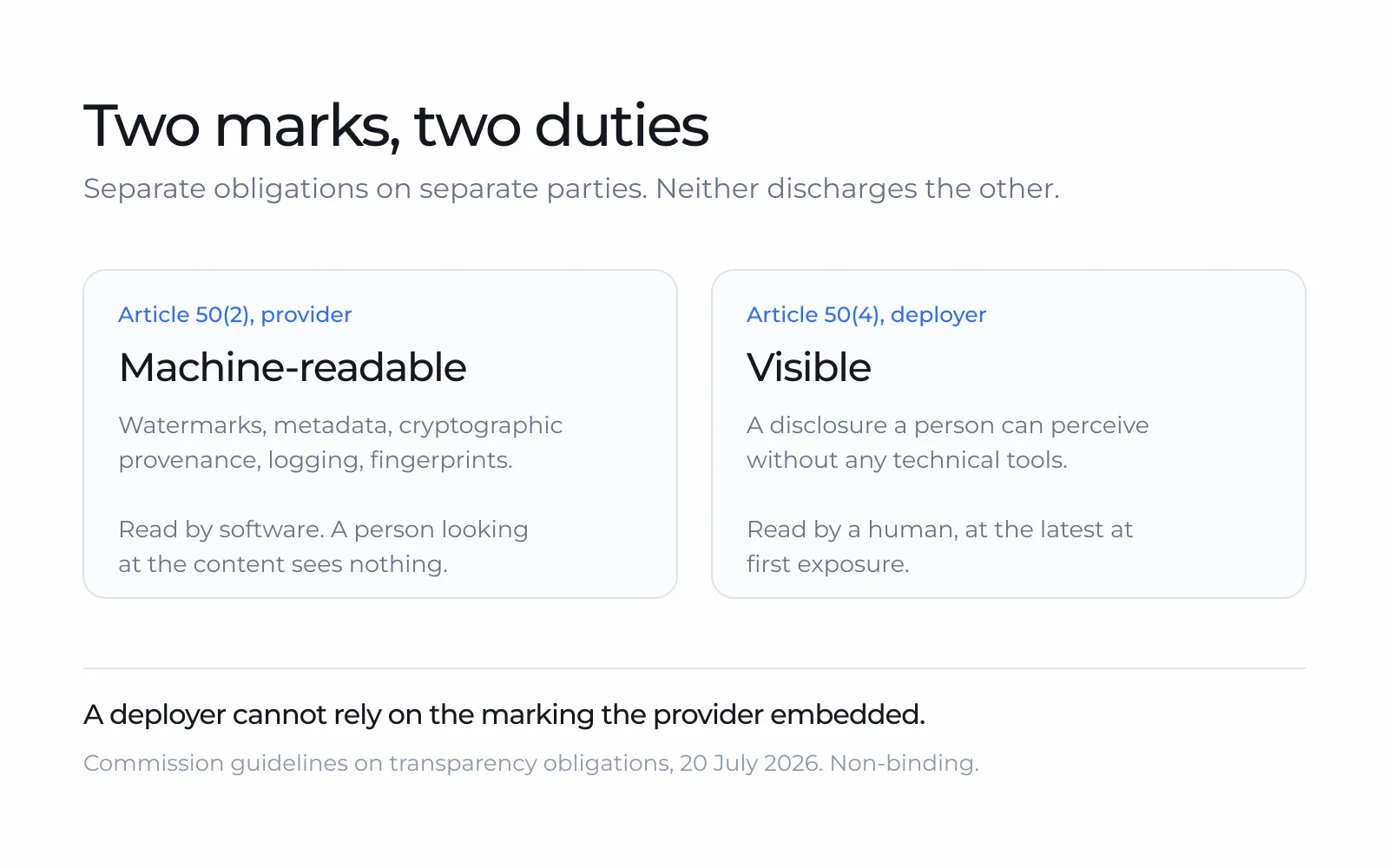
For a deployer: decide, per publication, whether the content meets the Article 50(4) trigger, and disclose where it does. The Commission has stated that a deployer cannot discharge this by pointing at the provider’s machine-readable marking, because the disclosure has to be perceivable by a person without special tools. That distinction is worked through in Visible Label or Machine-Readable Marking?, and the deepfake trigger itself in When Does an AI-Generated Image Need a Visible Label Under Article 50?.
If you hold both roles, the two sets of obligations run in parallel rather than merging. Discharging one has no bearing on the other.
Frequently asked questions
Am I a provider or a deployer if I use a commercial image generator for my business?
Using a tool someone else built and operates points to the deployer definition in Article 3(4): a person or body using an AI system under its own authority, other than in a personal non-professional activity. The provider definition in Article 3(3) turns on developing the system, or having it developed, and placing it on the market or putting it into service under your own name or trademark. Buying a subscription does neither of those things.
Can one company be both a provider and a deployer under the AI Act?
Yes, and it is common. The roles attach per AI system, not per organisation. A company that ships its own AI feature to customers is a provider of that system, and a deployer of every third-party system it uses internally. Article 50 obligations then have to be worked out system by system rather than once for the business.
Does the EU AI Act apply to a company based outside the EU?
Article 2(1) reaches providers placing AI systems on the Union market wherever they are established, deployers established or located in the Union, and providers and deployers in a third country where the output produced by the system is used in the Union. Being outside the EU is therefore not on its own a reason the Regulation does not reach an activity. How the output-used-in-the-Union limb applies to published content is not fully settled.
Does using open-source AI exempt me from Article 50?
No. Article 2(12) exempts AI systems released under free and open-source licences from parts of the Regulation, but it carves out systems placed on the market or put into service as high-risk systems and those falling under Article 5 or Article 50. The transparency obligations therefore continue to apply to open-source systems on their own terms.
Sources
- Regulation (EU) 2024/1689 (AI Act), Articles 2, 3, 25 and 50(opens in a new tab)Official Journal of the European Union
- Transparency obligations under Article 50 of the AI Act (FAQ)(opens in a new tab)European Commission
- Guidelines on transparency obligations for providers and deployers of certain AI systems(opens in a new tab)European Commission
- Small Businesses Guide to the AI Act(opens in a new tab)Future of Life Institute, AI Act Explorer