When Does an AI-Generated Image Need a Visible Label Under Article 50?
7 min read
Not every AI-generated image needs a visible label. Under Article 50(4) the disclosure duty falls on the deployer only where the image is a deepfake: content resembling a real person, object, place or event that could falsely appear authentic. A separate machine-readable marking duty falls on the provider under Article 50(2).
If you generate images with AI and publish them, the question is not whether the AI Act applies to you in the abstract. It is whether this image, in this context, carries a disclosure obligation. The answer is often no.
Article 50 does not require a label on every AI-generated image
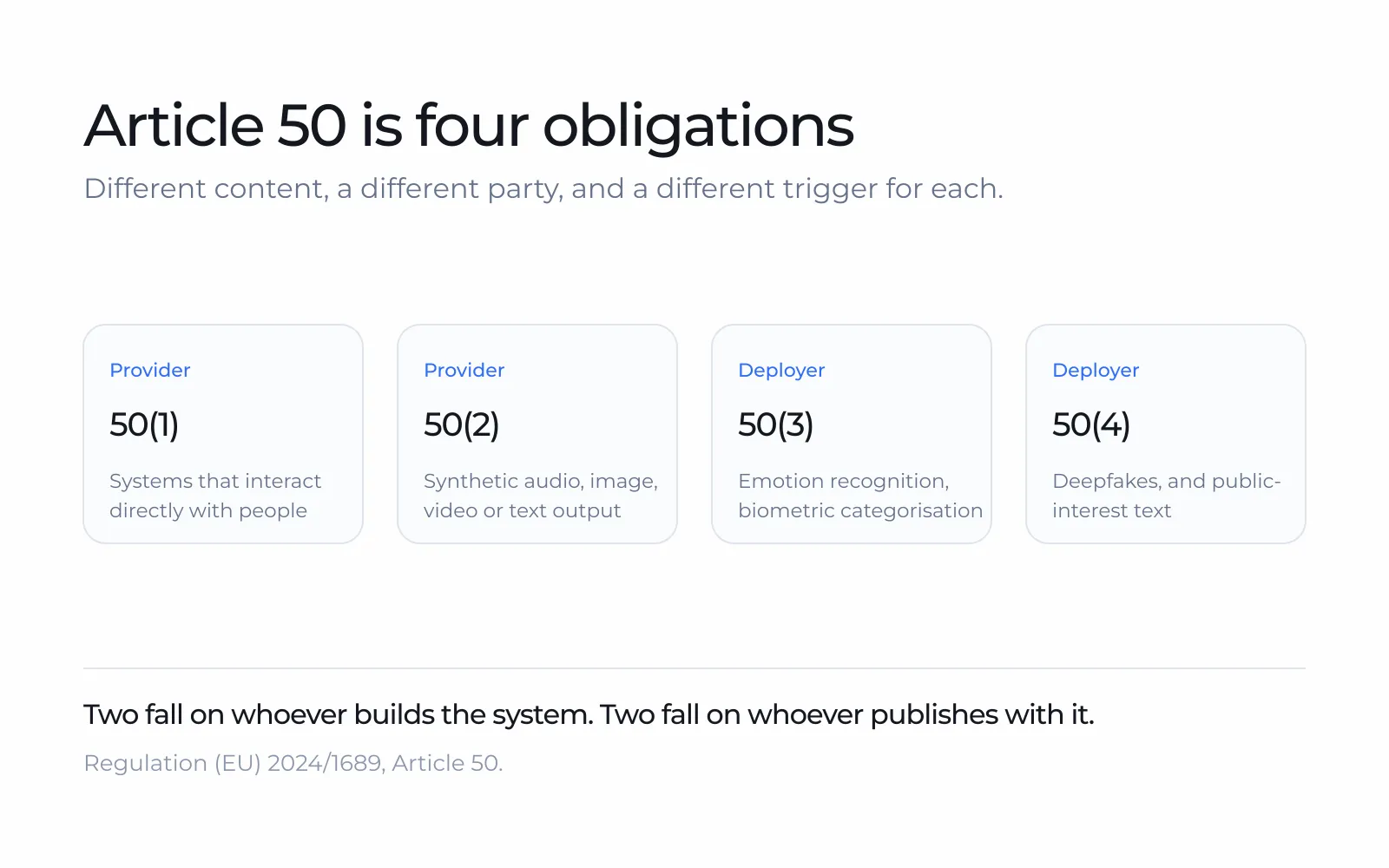
This is the most common misreading, and it is worth stating plainly before anything else. Article 50 of Regulation (EU) 2024/1689 does not impose a general “label all AI images” rule. It imposes two narrower, separate duties on two different parties:
- Article 50(2) requires providers of AI systems that generate synthetic audio, image, video or text to ensure the outputs are marked in a machine-readable format and detectable as artificially generated or manipulated. This is the model or tool vendor’s obligation, not the obligation of someone using the tool.
- Article 50(4) requires deployers of an AI system that generates or manipulates image, audio or video content constituting a deepfake to disclose that the content has been artificially generated or manipulated. This is the one that produces a visible label on a picture.
The distinction between the two roles is defined in Article 3. A provider develops an AI system and places it on the market under its own name or trademark. A deployer uses an AI system under its own authority, except where the use is a personal, non-professional activity. Most people asking this question (a marketing team, an e-commerce seller, a publisher) are deployers, and their exposure runs through Article 50(4), not 50(2). If that is not settled for you, work through Provider or Deployer? Which Article 50 Obligation Applies to You first, because it decides everything below.
Article 50 also contains two further duties this page does not cover: Article 50(1) on systems that interact with people, and Article 50(3) on emotion recognition and biometric categorisation. All four are mapped in Which AI-Generated Content Must Be Disclosed Under the EU AI Act?
What counts as a deepfake under the AI Act?
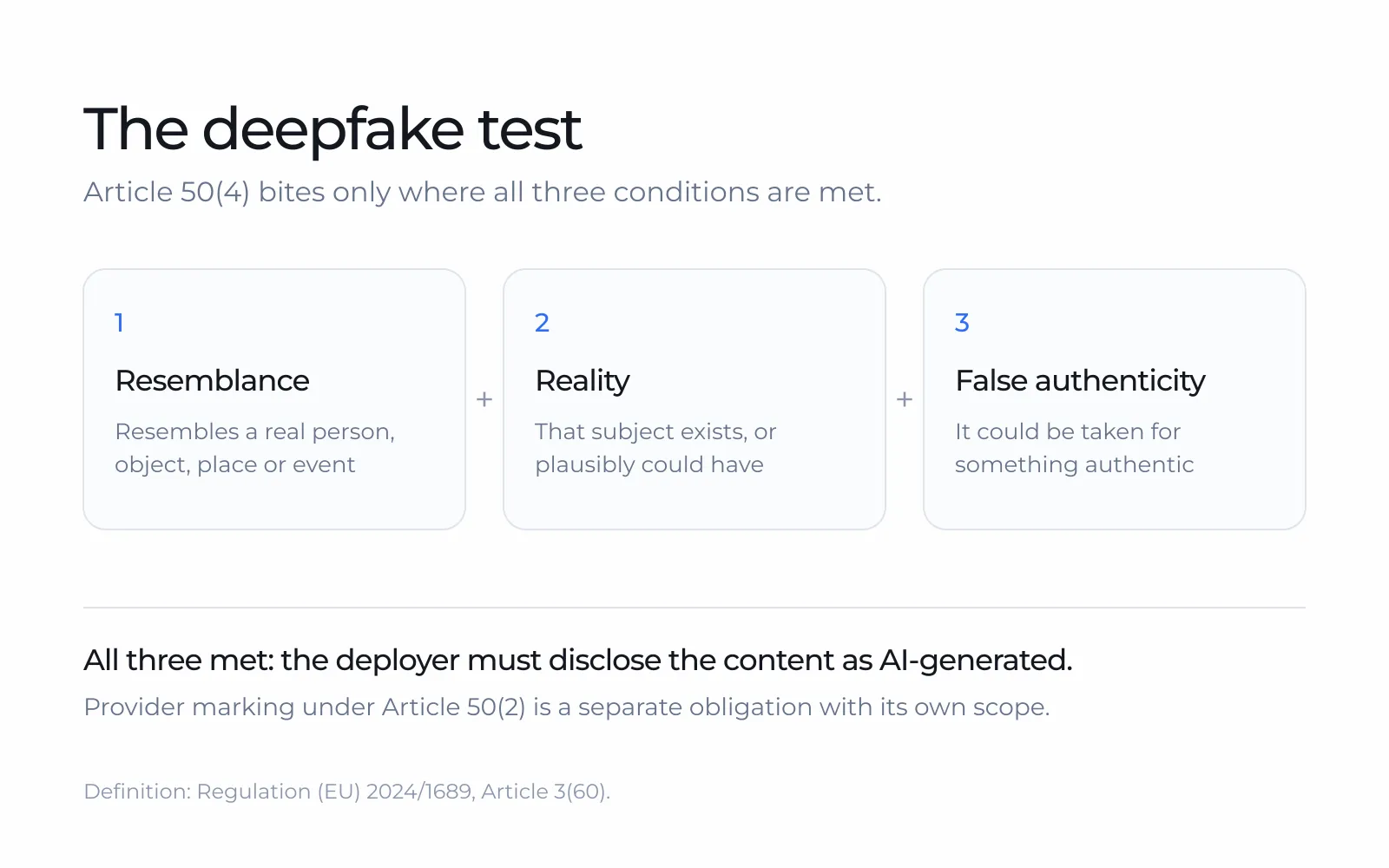
The AI Act defines it in Article 3(60): AI-generated or manipulated image, audio or video content that resembles existing persons, objects, places, entities or events and would falsely appear to a person to be authentic or truthful.
Read carefully, that definition contains three conditions, and the European Commission’s guidance treats them as cumulative, so all three must be met:
- Resemblance. There is a high level of similarity between the content and the subject it simulates.
- Reality. The subject resembles someone or something that exists, could plausibly exist, or could plausibly have existed.
- False authenticity. The content would falsely appear to a person to be authentic or truthful.
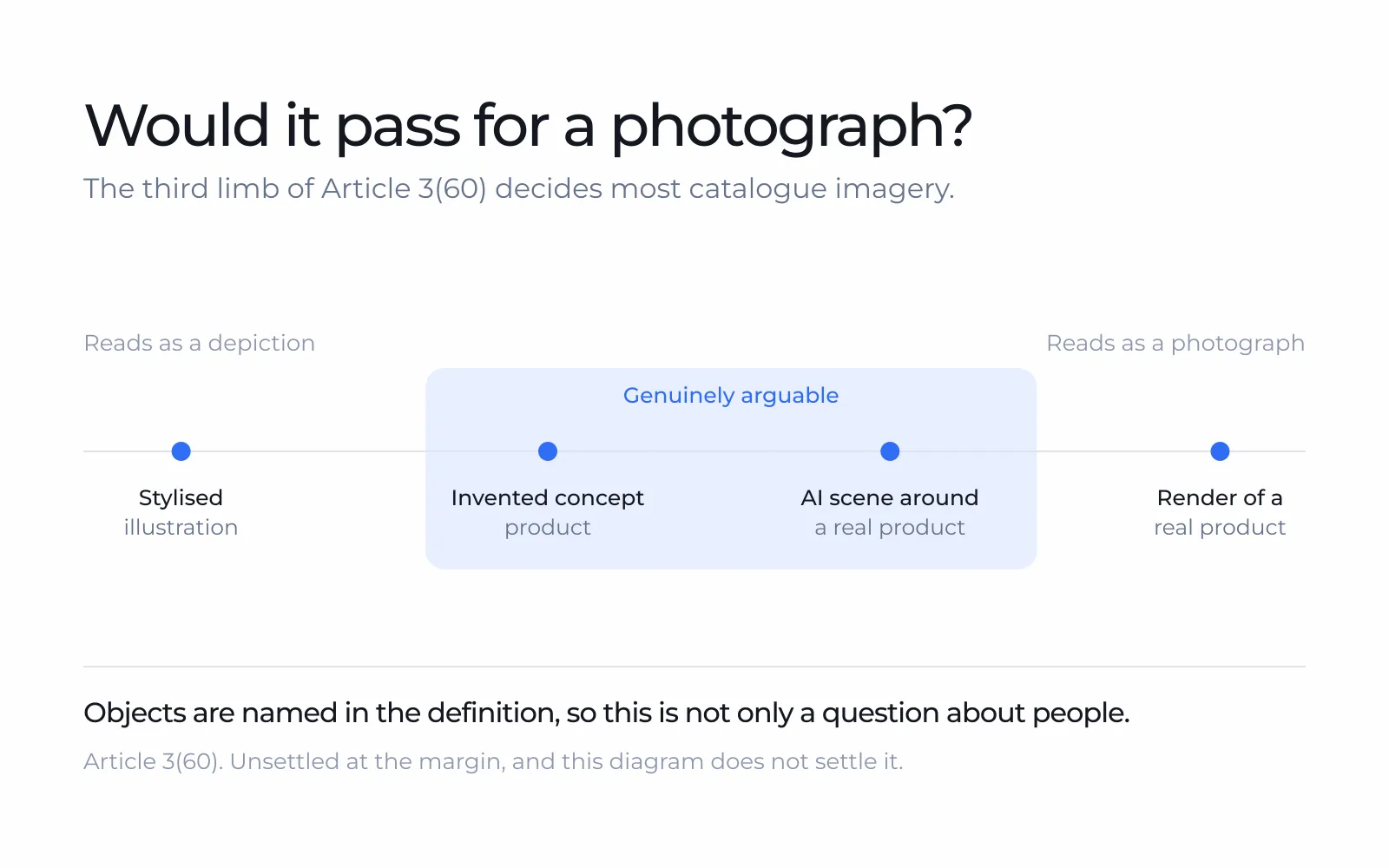
Note that the definition is not restricted to people. “Objects, places, entities or events” is doing real work: a photorealistic image of a product that does not exist, presented as a photograph of a real product, can fall inside it. That case is worked through in Do AI Product Photos and Renders Need an AI Label? An abstract illustration, a plainly stylised graphic, or a rendering of an object nobody would take for a photograph generally does not, because the third condition fails.
The Commission’s guidance indicates that the assessment is contextual rather than purely visual. The level of resemblance, the substantive message of the content, the deployment context, and the composition and expectations of the foreseeable audience all bear on it. That means the same image file can be a deepfake in one placement and not in another. It also means this is a judgement call, and a genuinely difficult one at the margin.
Who has to disclose: the provider or the deployer?
Both, but not the same thing, and the two do not substitute for each other.
The provider’s obligation under Article 50(2) is satisfied in the file’s metadata or signal: watermarking, provenance metadata, or a comparable technique. A person looking at the image sees nothing.
The deployer’s obligation under Article 50(4) is satisfied only by something a person can actually perceive. The Commission has stated that a deployer cannot simply rely on the machine-readable marking applied by the provider: the disclosure must be understandable and perceivable by natural persons, for example through a visible or audible label, without needing any specific technical tools or dedicated actions.
This is the single most practically important point on this page. If your compliance position is “the model we use watermarks its outputs,” that addresses the provider’s duty and leaves yours untouched. The two mechanisms are compared in detail in Visible Label or Machine-Readable Marking?
What does a compliant visible disclosure look like?
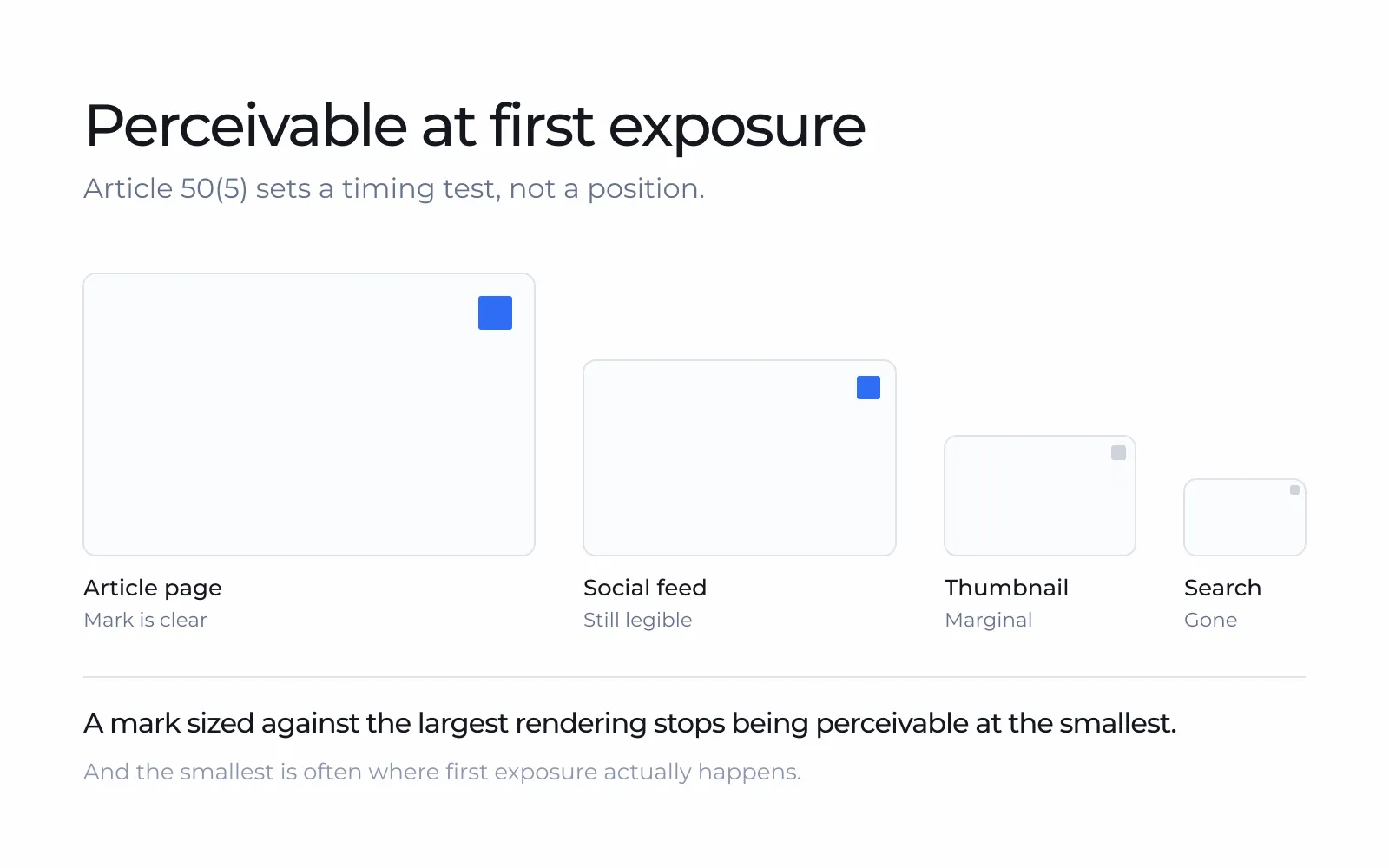
Article 50(5) sets the standard: the information must be provided to the persons concerned in a clear and distinguishable manner, at the latest at the time of the first interaction or exposure, and must conform with the applicable accessibility requirements.
The Commission’s guidance on its icon set adds practical expectations for images:
- Clearly perceivable and distinguishable at the latest at first exposure.
- Placed where no intervening overlay elements obscure it.
- Directly embedded into the content, so it survives resharing. There is a carve-out for creative works, discussed below.
- Rendered at a clearly visible size.
- Accompanied by accessible alt text.
“At the latest at the time of first exposure” is the clause that rules out the common workaround of putting the disclosure in a caption below the fold, in a comment, or in a page footer. If the image can be seen before the disclosure is read, the timing condition is not met. Applying that test surface by surface is the subject of Where Should an AI Disclosure Label Go on an Image?
Which of the three EU icons applies to your image?
The European Commission publishes a set of icons for labelling AI-generated content, in three variants, each supplied in black, white, and 50%-transparent black and white:
| Icon | Intended use |
|---|---|
| Basic icon | AI was involved in creating deepfake or published text content. |
| Fully AI-Generated | Content created entirely by AI, with no human contribution beyond prompting. |
| Partially AI-Modified | Human-made content that has been altered using AI. |
Two things about them are easy to get wrong.
Using them is optional; disclosing is not. The Commission is explicit that the use of the EU icons is optional while the labelling requirements under Article 50 are not. You may disclose another way, provided it meets the Article 50(5) standard.
Using them does not establish compliance. The icon is the form a disclosure takes. Whether a disclosure was required, whether it was timely, and whether it was perceivable remain your responsibility as deployer. An icon on an image that did not need one is harmless; an icon placed where nobody sees it does not cure a breach.
Choosing between “Fully AI-Generated” and “Partially AI-Modified” turns on whether a human-authored work underlies the output. A photograph retouched with a generative fill is modified; an image produced from a text prompt alone is generated.
When does the artistic, satirical or fictional exception apply?
Article 50(4) contains a carve-out for content forming part of an evidently artistic, creative, satirical, fictional or analogous work or programme. It is narrower than it is usually described.
The exception does not remove the obligation. It limits how the disclosure is made: to disclosing the existence of the generated or manipulated content in an appropriate manner that does not hamper the display or enjoyment of the work. A film using synthetic de-ageing is not excused from disclosure; it is permitted to disclose in the credits rather than by stamping every frame.
The word carrying the weight is evidently. The work has to read as creative or satirical to its audience. Commercial imagery presented as documentary is not brought inside the exception by an internal view that it was a creative project.
There is a further exception in Article 50(4) for uses authorised by law to detect, prevent, investigate or prosecute criminal offences, which will not be relevant to most publishers.
What changed on 2 August 2026, and what is still moving
Article 50 sits in Chapter IV of the AI Act and became applicable on 2 August 2026. Two timing points matter for anyone auditing an existing image library:
- The Commission has stated that content generated before 2 August 2026 does not need to be labelled retroactively, though it encourages voluntary compliance.
- A grace period to 2 December 2026 applies only to the Article 50(2) machine-readable marking obligation, and only for AI systems placed on the market before 2 August 2026. It does not extend the deployer’s Article 50(4) disclosure duty.
Penalties for breaching Article 50 fall under Article 99(4): up to €15 million or 3% of total worldwide annual turnover, whichever is higher.
Two instruments now sit alongside the text and are worth tracking, because both are recent and neither is legislation:
- Commission guidelines on the transparency obligations, adopted on 20 July 2026. They are non-binding, but they are the Commission’s own interpretation and the closest thing available to an authoritative reading.
- A Code of Practice on Transparency of AI-generated Content, published on 10 June 2026 and signed by roughly 190 organisations by the end of July 2026. Adherence is voluntary; the Commission and the AI Board have confirmed it as an adequate voluntary tool for demonstrating compliance.
This is an area where the guidance is younger than the obligation. Where this page states what the Commission has said, it links the source so you can check whether it still says it.
Frequently asked questions
Does every AI-generated image need a label under the EU AI Act?
No. Article 50(4) requires a deployer to disclose an image only where it is a deepfake: AI-generated or manipulated content that resembles an existing person, object, place, entity or event and would falsely appear authentic. A product render of an invented object, an abstract illustration, or a clearly stylised graphic does not meet that definition. A separate obligation in Article 50(2) requires providers of generative AI systems to mark outputs in a machine-readable format, and that one is not limited to deepfakes.
Is using the official EU AI icons mandatory?
No. The European Commission states that use of its icons is optional, while the labelling obligations under Article 50 are not. You may disclose in another way, provided the disclosure is clear, distinguishable and perceivable by a person at the latest at the time of first exposure. The icons are a convenience that makes a disclosure recognisable across the single market, not a legal requirement in themselves.
Is machine-readable marking enough, or do I need a visible label too?
They are different obligations on different parties. Machine-readable marking under Article 50(2) is the provider's duty. The Commission has stated that a deployer subject to the Article 50(4) deepfake disclosure cannot simply rely on the provider's machine-readable marking: the disclosure must be understandable and perceivable by a natural person, for example through a visible label, without needing special tools.
Do I have to label AI images I published before 2 August 2026?
The European Commission has stated that content generated before 2 August 2026 does not need to be labelled retroactively, while encouraging voluntary compliance. Separately, a limited grace period runs to 2 December 2026, but it applies only to the Article 50(2) machine-readable marking obligation and only to AI systems placed on the market before 2 August 2026.
Sources
- Regulation (EU) 2024/1689 (AI Act), Articles 3, 50 and 99(opens in a new tab)Official Journal of the European Union
- Transparency obligations under Article 50 of the AI Act (FAQ)(opens in a new tab)European Commission
- Guidelines on transparency obligations for providers and deployers of certain AI systems(opens in a new tab)European Commission
- EU icons for labelling AI-generated content(opens in a new tab)European Commission
- Code of Practice on Transparency of AI-generated Content(opens in a new tab)European Commission