Do AI Product Photos and Renders Need an AI Label?
6 min read
Article 3(60) covers content resembling existing objects, not only people, so a photorealistic AI render presented as a photograph of a real product can fall inside the deepfake definition and trigger the Article 50(4) disclosure duty. A plainly stylised graphic or an invented concept product usually fails the third limb of the test, because no viewer would take it for something authentic.
This is the question the AI Act is most often assumed to have an obvious answer to, in both directions. One reading has every AI-touched product shot carrying a label. The other has none of them, on the basis that Article 50(4) is about politicians and celebrities. Both are wrong, and the text is the reason.
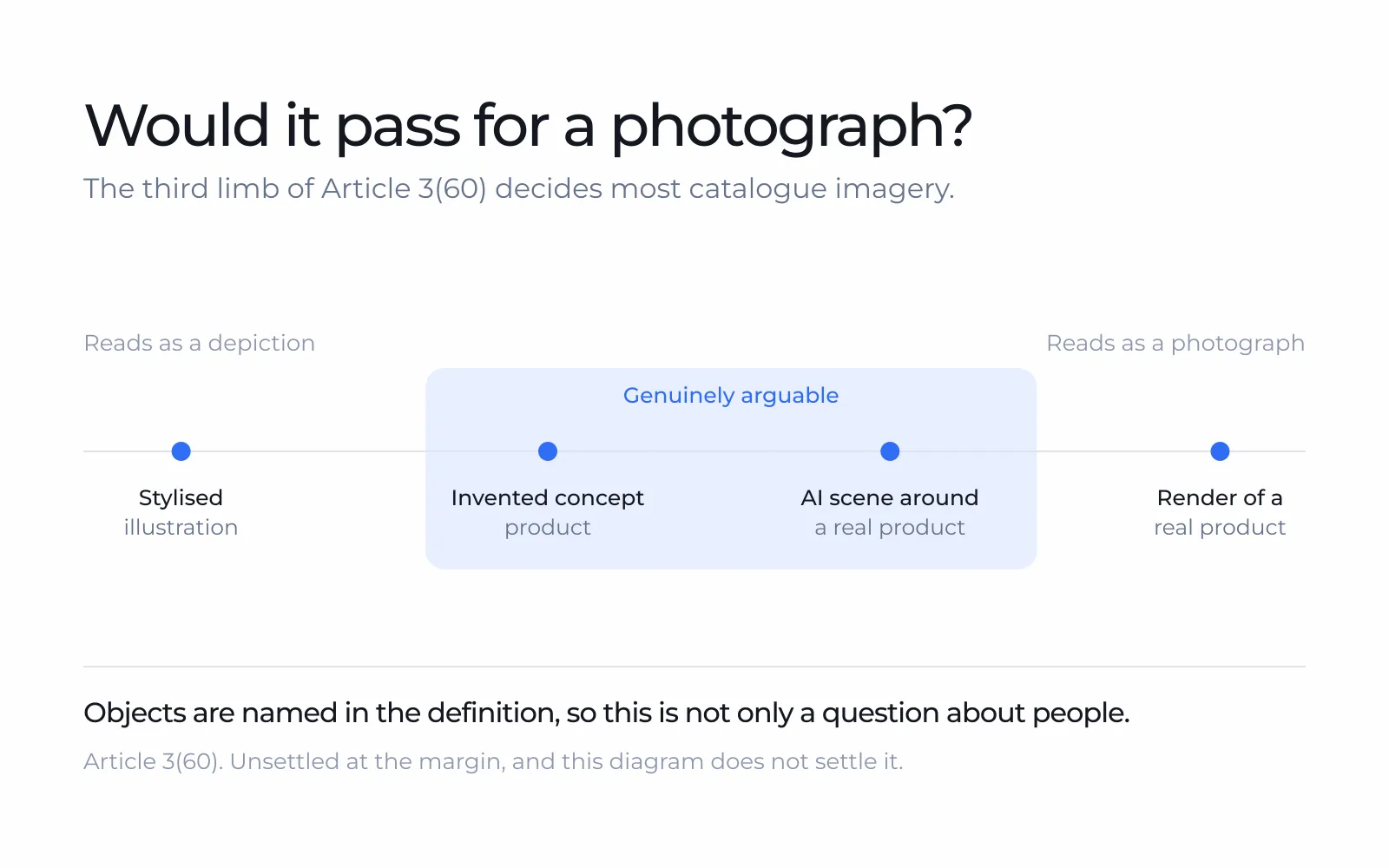
The question is whether the image would pass for a photograph of a real product
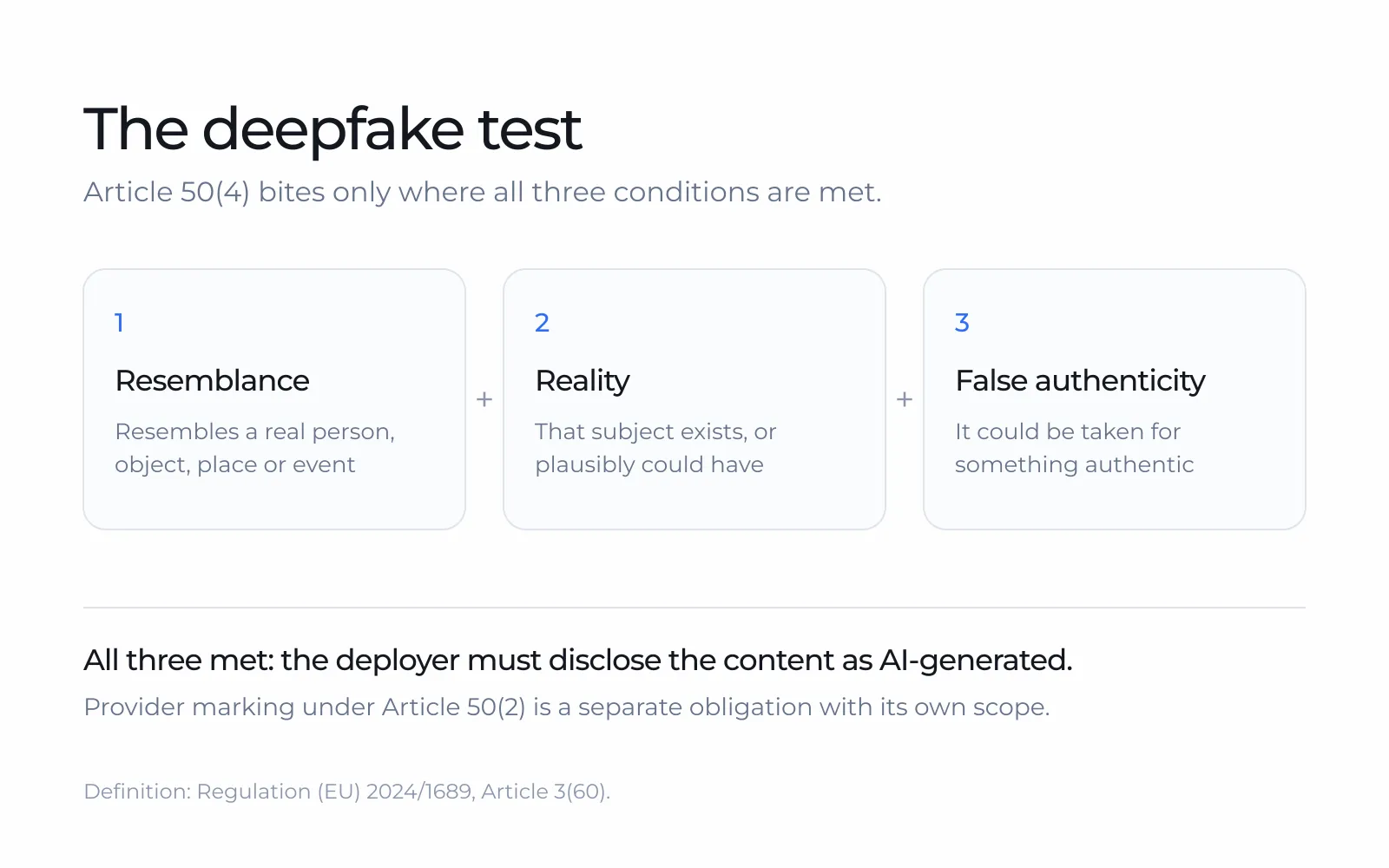
The general deepfake test is worked through in When Does an AI-Generated Image Need a Visible Label Under Article 50? Applied to commerce, it reduces to something a merchandiser can actually assess:
The third limb is where most catalogue imagery is decided, and it is contextual. The Commission describes an assessment that takes in the level of resemblance, the substantive message, the deployment context, and the composition and expectations of the foreseeable audience. The same file can therefore be inside the definition on a product listing and outside it in a mood board.
The Article 3(60) test names objects, not only people
‘deep fake’ means AI-generated or manipulated image, audio or video content that resembles existing persons, objects, places, entities or events and would falsely appear to a person to be authentic or truthful.
“Objects” sits in the middle of that list and does real work. Reading Article 50(4) as a rule about impersonating people is the most common way an e-commerce team concludes the provision has nothing to do with them.
There is a wording difference worth knowing about. Recital 134 describes content that “appreciably resembles” existing persons, objects, places, entities or events. The word appreciably does not appear in the Article 3(60) definition itself. Recitals aid interpretation without overriding the enacting text, so the threshold the recital implies is a reasonable interpretive argument rather than a qualifier you can rely on as though it were in the definition.
Four e-commerce cases, worked
None of these is a determination. Each sets out how the limbs fall and where the argument sits.
A photorealistic render of a product you actually sell, used as the listing image. All three limbs are engaged on the natural reading: it resembles an existing object, that object exists, and it occupies the position a photograph occupies, so a shopper would take it for one. This is the strongest case for disclosure in ordinary e-commerce.
An AI-generated lifestyle scene around a real product. The product is real and the setting is invented. The image reads as a photograph of a scene that never occurred. The resemblance and reality limbs are engaged by the product, and the false-authenticity limb turns on whether a shopper would understand the scene as staged. Catalogue conventions cut both ways here, which is discussed below.
A fully invented concept product that does not exist. The reality limb is the pressure point. Article 3(60) asks about resemblance to existing subjects, and the Commission reads the subject as one that exists or could plausibly exist. A plausible-looking product that does not exist may well satisfy it, and presenting a non-existent product as available raises consumer-protection questions of its own regardless of the AI Act.
A plainly stylised illustration or an abstract graphic. The third limb generally fails: nobody takes it for a photograph. This is the clearest case for no Article 50(4) disclosure, and over-labelling it has a cost, because a mark that appears on everything stops carrying information.
Generative fill and retouching: where the standard editing line sits
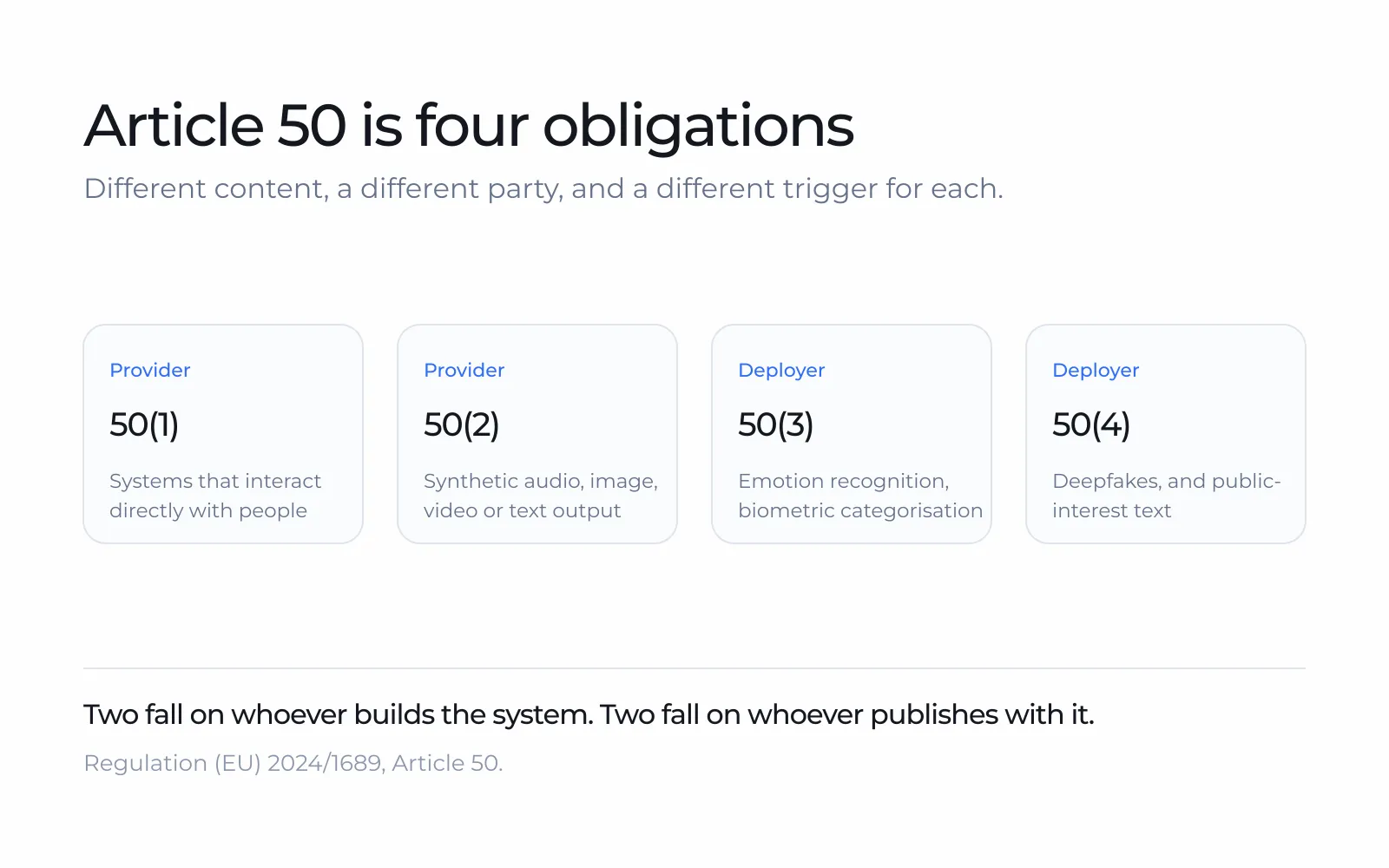
Article 50(2) carves out AI systems performing an assistive function for standard editing, and those not substantially altering the input data provided by the deployer or the semantics of that data. Recital 133 repeats the carve-out as a proportionality measure.
Two things about that carve-out are routinely misapplied to product photography.
It is the provider’s carve-out, not yours. Article 50(2) is addressed to whoever supplies the editing system. Whether your retouching tool has to mark its output is a question about that tool. It says nothing about whether you have to disclose the resulting image.
Semantics is the test, not effort. Adjusting exposure, correcting colour or removing a dust speck changes how an image looks. A generative fill that adds a second product to the shot, removes a defect that exists on the real item, or extends a background to a different aspect ratio changes what the image asserts. The second group is where the semantics limb becomes hard to lean on, and where the separate Article 50(4) question arises on its own terms.
The practical consequence: a small edit is not automatically outside the rules, and a large one is not automatically inside them. What the edit changed about the claim the image makes is the thing to look at.
AI models wearing real products
Synthetic human figures in fashion and beauty imagery engage the first limb of Article 3(60) most directly, because the definition names persons first.
Where the figure is generated to resemble an identifiable real person, the resemblance and reality limbs are engaged plainly, and rules outside the AI Act become relevant at the same time. Personal data law and national image or personality rights can apply where a real person is recognisable, and they do so independently of any Article 50 analysis.
Where the figure is wholly invented, the position is less settled. The definition asks about resemblance to existing persons, and a model who does not exist is not an existing person. Against that, the Commission’s reading includes subjects that could plausibly exist, and a photorealistic human figure plainly could. We are not aware of guidance or an enforcement decision resolving this either way, so treat it as open.
Article 50 is not the only rule on a product page
Article 50(6) says the transparency obligations are without prejudice to other transparency obligations laid down in Union or national law. On a product page that matters more than usual.
Directive 2005/29/EC on unfair business-to-consumer commercial practices treats as a misleading action the provision of false information about the main characteristics of a product, including its composition, its specification and the results to be expected from using it. An image is information for these purposes. A render that shows a finish, a size relationship or a level of performance the real item does not have raises a question under that Directive whether or not it is a deepfake within Article 3(60).
Marketplace and platform policies are a third layer, set contractually rather than by law, and several already require synthetic imagery to be declared. They bind you through your seller agreement independently of anything in the Regulation.
The three regimes overlap without lining up. An image can be outside Article 50(4) and still be a problem under consumer law, or acceptable under both and still breach a marketplace policy.
What to do where the answer is genuinely arguable
This article deliberately stops short of telling you which of your images need a label, because the third limb of Article 3(60) is a contextual judgement about your audience and your placement, and no page can make it at a distance.
What is available is a way of recording the decision. For each class of image, write down what the image depicts, whether that subject exists, how it is presented, and which way you read the false-authenticity limb and why. A documented reading of a genuinely unsettled provision is a materially different position from an undocumented assumption, and it is the artefact you would want if the question is ever asked.
Where you conclude a disclosure is warranted, the mechanics of placing it are in Where Should an AI Disclosure Label Go on an Image? Where you are still working out which obligation is yours in the first place, start with Provider or Deployer?
Frequently asked questions
Do AI-generated product images need an EU AI Act label?
Some do. Article 50(4) attaches to deepfakes, and Article 3(60) defines those as AI-generated or manipulated image, audio or video content resembling existing persons, objects, places, entities or events that would falsely appear to a person to be authentic or truthful. A photorealistic render of a real product, presented in the position a photograph would occupy, engages every limb of that definition. A plainly illustrative or stylised product graphic generally does not, because a viewer would not take it for a photograph.
Does using generative fill on a product photo trigger Article 50?
It depends on what the fill changed. Article 50(2) excludes AI systems performing an assistive function for standard editing or not substantially altering the input data or its semantics, and that is the provider obligation. The deployer duty in Article 50(4) runs on its own test: if the edited image now depicts something that did not exist and would read as authentic, the deepfake definition is engaged regardless of how small the edit was.
Do AI fashion models need to be disclosed under the AI Act?
A synthetic human figure resembling an existing person engages the first limb of Article 3(60) directly, and the assessment then turns on whether the image would falsely appear authentic. A wholly invented figure is a harder case, because the definition asks about resemblance to existing persons, and the Commission treats the subject as one that exists or could plausibly exist. Separate rules on personal data and image rights can apply where a real person is recognisable, independently of the AI Act.
Is a 3D render of a product a deepfake under the AI Act?
Article 3(60) applies to AI-generated or manipulated content, so a render produced by conventional 3D software rather than an AI system falls outside it on that ground alone. Where the render is AI-generated, the question becomes whether it resembles an existing object and would falsely appear authentic. Product photography has long included heavy retouching, and a viewer expectation that catalogue images are idealised is part of the contextual assessment the Commission describes.
Sources
- Regulation (EU) 2024/1689 (AI Act), Articles 3 and 50(opens in a new tab)Official Journal of the European Union
- Regulation (EU) 2024/1689, Recital 134(opens in a new tab)Official Journal of the European Union
- Transparency obligations under Article 50 of the AI Act (FAQ)(opens in a new tab)European Commission
- Guidelines on transparency obligations for providers and deployers of certain AI systems(opens in a new tab)European Commission
- Directive 2005/29/EC on unfair business-to-consumer commercial practices(opens in a new tab)Official Journal of the European Union