Where Should an AI Disclosure Label Go on an Image?
6 min read
Article 50(5) does not specify a corner. It requires the disclosure to reach the people concerned in a clear and distinguishable manner at the latest at the time of first exposure, which rules out a caption below the fold, a comment, or a page footer. The Commission adds that its icon should be embedded directly in the content so it stays visible when the content is reshared.
Placement is where an otherwise correct Article 50 position falls over. The decision that the content needs a disclosure has been made, the icon has been chosen, and then the mark goes somewhere a viewer reaches after they have already seen the picture.
Article 50(5) sets a timing test, not a position
The information referred to in paragraphs 1 to 4 shall be provided to the natural persons concerned in a clear and distinguishable manner at the latest at the time of the first interaction or exposure. The information shall conform to the applicable accessibility requirements.
Three requirements, and no geometry:
Because the test is about timing and clarity rather than position, no single placement is mandated and no single placement is safe everywhere. The question to ask of any candidate position is whether the content can be seen without it.
What “at the latest at the time of first exposure” rules out
This clause does most of the work, and it disposes of the placements teams reach for first:
- A caption below the fold. The image renders, the viewer sees it, the disclosure is still off screen.
- A comment, or the first reply. Not shown by default on most surfaces.
- A page footer, or an “about our content” page. Neither is encountered at the moment of exposure.
- An expandable description. A viewer who does not tap it never receives the disclosure.
- The second slide of a carousel. Slide one has already been exposed.
- Alt text alone. It is not perceivable by a sighted viewer at all, and Article 50(5) asks for the disclosure to reach the persons concerned rather than a subset of them.
None of these is disqualified by name in the Regulation. Each fails the same test for the same reason, which is why the test is worth applying directly rather than working from a list.
Embed the label in the image, not in the page
The Commission’s guidance on its icon set is more specific than the Regulation, and it is the closest thing to a placement rule currently available. For images, it asks that the icon be:
- Clearly perceivable and distinguishable at the latest at the time of first exposure.
- Positioned so that no overlay elements obstruct it.
- Directly embedded into the content, with an exception for creative works.
- Still visible if the content is reshared or downloaded.
- Rendered at a clearly visible size.
- Accompanied by alt text or an ARIA label for assistive technologies.
The embedding expectation is the one with engineering consequences. A disclosure rendered as a page element beside the image is a property of your page, not of the file. Anyone who right-clicks and saves, or reshares to a platform that fetches the image directly, receives the picture without it. A mark rendered into the pixels is part of the picture and travels with it.
Use of the icons themselves remains optional. The Commission states plainly that “the use of these EU icons is optional, but the labelling requirements under Article 50 AI Act are not”. You may disclose in another form as long as it meets Article 50(5).
Placement surface by surface
The same file behaves differently depending on where it is published. What follows is operational rather than legal: the Regulation sets one test, and these are the conditions that make a given placement fail it.
| Surface | What breaks a placement | What to check |
|---|---|---|
| Your own website | Lazy loading and lightboxes can delay the surrounding caption while the image renders | The mark is in the file, not in the template |
| Social feeds | Automatic centre-cropping of the preview; aspect-ratio changes between feed and detail view | The mark survives the feed crop, not only the full view |
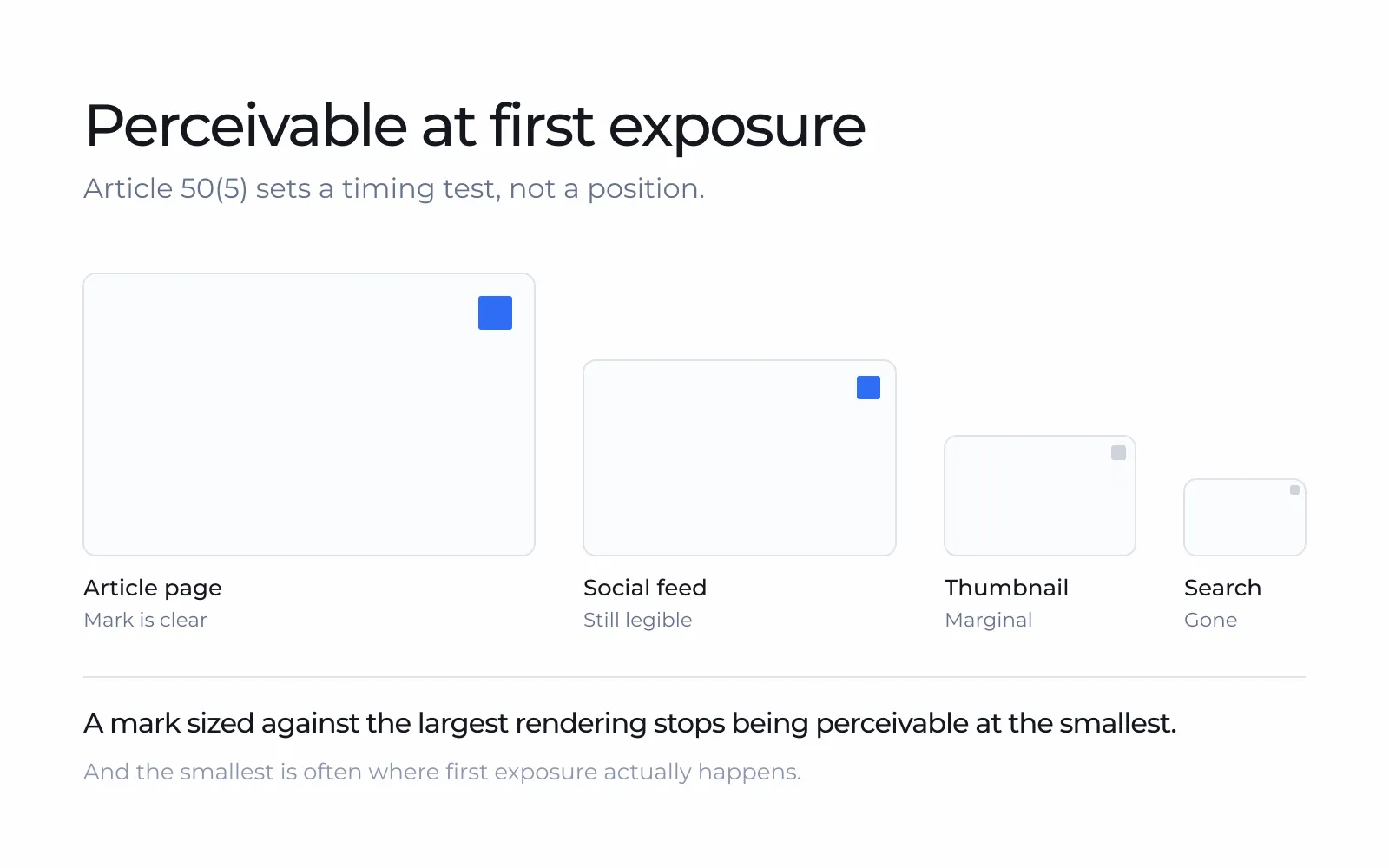
| Product pages and marketplaces | Thumbnail grids, zoom views and gallery re-crops; platform image pipelines re-encode | The mark is legible at the smallest thumbnail used |
| Video | A mark on frame one is gone by frame two; autoplay muted previews | Persistent or repeated on-screen disclosure, or the creative-work route below |
| Images blocked by default; scaling on mobile clients | The disclosure does not depend on the image loading |
The recurring failure is the same in each row. A placement chosen against the largest rendering of an image stops being perceivable at the smallest one, and the smallest one is often where first exposure actually happens.
Size, contrast and the corner problem
Neither the Regulation nor the Commission gives pixel dimensions, so the practical constraint is the one just described: the mark has to hold up at the smallest surface the image appears on.
Contrast is the second constraint and the easier one to get wrong, because it varies per image rather than per template. A black mark placed in a corner that happens to be dark is not distinguishable within the meaning of Article 50(5), even though the same mark in the same position works on the next image. The Commission supplies each icon in black, white, and black and white at 50% transparency, which exists to be chosen per image rather than set once.
Corners are the conventional position because they are least likely to sit over the subject. They are also where platforms place their own overlays, such as duration badges, sponsored markers and profile avatars. The Commission’s “no overlay elements obstruct it” expectation is a reason to check the corner your chosen surface leaves free rather than to standardise on one globally.
Accessibility is part of the obligation, not an extra
Article 50(5) closes with a requirement that the information conform to the applicable accessibility requirements. It does not name the instrument that supplies them, and which rules apply depends on who you are and what you publish.
What follows for a visible image label is that pixels alone reach only sighted viewers. Alt text or an ARIA label, written where you publish, is what carries the disclosure to a screen reader. The Commission’s icon page asks for exactly this alongside the visible mark, and adds two expectations that go beyond it: extended visibility for people with cognitive difficulties, and navigable interactive layers where further information is offered.
The creative-work exception changes where, not whether
Article 50(4) limits the transparency obligation where the content forms part of an evidently artistic, creative, satirical, fictional or analogous work or programme. The limitation is on the manner of disclosure: it becomes disclosure of the existence of the generated or manipulated content “in an appropriate manner that does not hamper the display or enjoyment of the work”.
For placement, that is the difference between marking every frame of a film and disclosing in the credits. The Commission’s own embedding expectation carries an explicit exception for creative works for the same reason.
The load-bearing word is evidently. The work has to read as creative to its audience rather than to its producer, so commercial imagery presented as documentary is not brought inside the exception by an internal view that the project was a creative one. Whether a given piece qualifies is a judgement, and this page cannot make it for you.
For the prior question of whether an image needs a disclosure at all, see When Does an AI-Generated Image Need a Visible Label Under Article 50? For the distinction between this visible mark and the provider’s invisible one, see Visible Label or Machine-Readable Marking?
Frequently asked questions
Where should an AI disclosure label be placed on an image?
Article 50(5) sets a timing and clarity test rather than a position: the disclosure must reach the people concerned in a clear and distinguishable manner at the latest at the time of first exposure. The Commission adds for its icon set that it should be clearly perceivable and distinguishable at first exposure, positioned where no overlay elements obstruct it, embedded directly into the content, and rendered at a clearly visible size. A corner of the image itself satisfies all of those in most layouts.
Does putting the AI disclosure in the caption satisfy Article 50?
It depends on whether the caption is read before or at the same time as the image is seen. Article 50(5) requires disclosure at the latest at the time of first interaction or exposure, so a caption that a viewer meets only after scrolling, expanding a description, or opening a comment thread does not meet the timing condition. A caption rendered immediately adjacent and visible at the same moment is a different case, though it does not travel with the file if the image is reshared.
Do I have to label every image in a carousel or gallery?
Article 50(5) attaches to the first exposure of the content concerned, and each image in a carousel is separately exposed when a viewer reaches it. A disclosure on the first slide alone leaves later slides unlabelled at their own moment of first exposure. Labelling each image that meets the Article 50(4) trigger avoids the question, and is also what survives a single slide being reshared on its own.
What size should an AI disclosure label be?
Neither Article 50 nor the Commission specifies pixel dimensions. The Commission asks that the icon be rendered at a clearly visible size and be clearly perceivable and distinguishable at the latest at first exposure. In practice the constraint is the smallest surface the image is shown on, such as a feed thumbnail or a search result, since a mark that disappears at that size is not perceivable at the moment the viewer first meets the content.
Sources
- Regulation (EU) 2024/1689 (AI Act), Article 50(opens in a new tab)Official Journal of the European Union
- EU icons for labelling AI-generated content(opens in a new tab)European Commission
- Transparency obligations under Article 50 of the AI Act (FAQ)(opens in a new tab)European Commission
- Guidelines on transparency obligations for providers and deployers of certain AI systems(opens in a new tab)European Commission